
Strategic Risk Management: A Full Guide for High-Stakes Projects

In the professional world, risk is often mistakenly equated with failure. In reality, however, risk is simply the difference between a plan and its execution. To manage high-stakes projects effectively, it is crucial to stop viewing risk as an emergency to be managed and start viewing it as a resource to be optimised.
Effective risk management enables you to distinguish between 'productive uncertainty' (innovation) and 'toxic waste' (preventable failures). This guide provides a framework for identifying high-risk factors and building a system that can withstand shocks.
2. Identifying High-Risk Factors
Not all risks are created equal. To build a resilient project, you must categorise threats into three distinct groups:
A. Strategic Risks (The "What")
These relate to the validity of your goals.
- Scope creep: the gradual expansion of project requirements without a proportional increase in resources.
- Market shift: The risk that the project’s output will become irrelevant before completion.
B. Operational Risks (The "How")
These are all about the mechanics of your work.
- Resource Depletion: Overestimating your (or your team’s) capacity can lead to burnout.
- Technical Debt: Using suboptimal tools or processes that save time now but create massive “waste” later.
C. External Risks (The "Environment")
These are factors that are outside your direct control, such as sudden regulatory changes or technological disruptions.
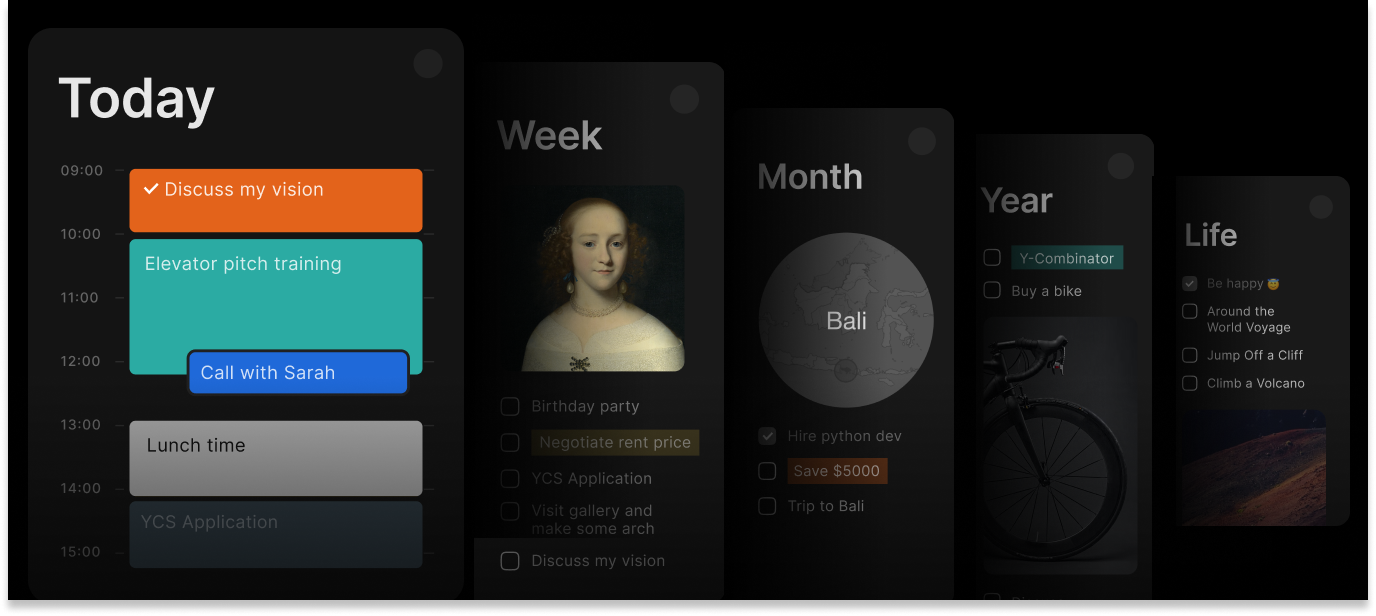
Timestripe is a smart, well-designed workspace for all your projects, tasks and notes.
Try it today
Get Started3. The Risk Mitigation System: Identify, Assess, Respond
Identifying a problem is only half the battle. The real work begins when you decide how to handle the threats you have identified. The following framework is based on the ISO 31000 risk management standard combined with the pre-mortem strategy developed by psychologist Gary Klein.
Research shows that performing a “pre-mortem”, which involves imagining that a project has already failed and identifying the cause, can increase the ability to correctly predict future outcomes by 30%.
Try this step-by-step workflow to turn that insight into action:
Timestripe is a smart, well-designed workspace for all your projects, tasks and notes.
Try it today
Get Started4. Applying the Framework: Using Timestripe as Your Risk Infrastructure
A strategy is just words until it’s in your planner. Timestripe is built to handle this exact cycle:
Risk is often the result of 'tunnel vision' — becoming so focused on today’s tasks that you overlook next month’s deadlines. Timestripe Horizons feature enables you to conduct an ongoing 'pre-mortem' analysis by viewing your daily actions in the context of your yearly goals.
2. Just as industrial waste management protects the environment, Timestripe protects your focus. Use separate boards to separate “someday” ideas from “current” tasks. Avoid cognitive overload and decision fatigue by keeping your active workflow clean.
3. The Weekly Retrospective as Risk Audit At the end of every week, Timestripe’s Weekly View allows you to review your performance. This is where you can identify any recurring risks. If a certain type of task always takes longer than planned, your “estimation risk” is high. You can then adjust your future planning to account for this.
5. Conclusion: Transforming from reactive to resilient
At Timestripe, we believe that preparation is key, and this mindset is anything but pessimistic. By using a system like Timestripe to identify high-risk factors early and monitor your progress across multiple horizons, you can transform uncertainty into a competitive advantage.
Read next



Dont let your project become a casualty of poor planning.
Take the first steps now with Timestripe
Get Started