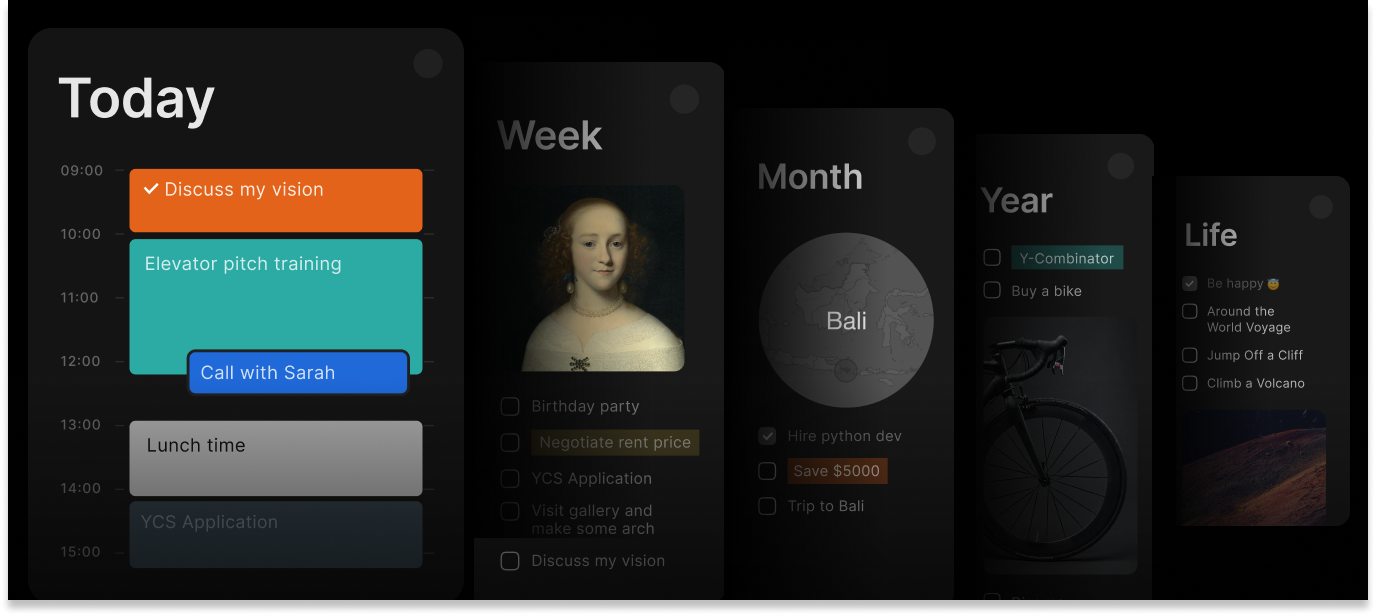
Dan Freeman, Unsplash
A yearly goal is easy to write and hard to start. "Learn Spanish" or "launch my own studio" sounds clear in January, but on a Tuesday in March it does not tell you what to do in the next hour. The goal is fine. What is missing are the layers between the year and the week.
Breaking a goal down is not the same as making a long to-do list. A list of fifty tasks for the year goes out of date within a month. A layered plan stays useful because each layer is detailed only as far as you can see.
Start From the End of the Year
Write down what is true when the goal is reached. Not "get better at Spanish", but "hold a thirty-minute conversation with a native speaker without switching to English". A result you can check gives every layer below it something to aim at.
If you cannot describe the end result, the goal is still a direction. That is fine, but then the first quarter's milestone becomes "decide what the result is", and the rest of the plan waits for it.
Split the Year Into Quarters
A quarter is long enough for real progress and short enough to see the end of. Ask what has to be true at the end of each quarter for the yearly result to happen. Four milestones are usually enough.
The milestones do not need to be equal. A new skill often moves slowly at first and faster later. A project often has a heavy start and a long tail. Let the milestones follow the shape of the work rather than the calendar.
Turn the Current Quarter Into Monthly Results
Detail only the quarter you are in. Split its milestone into three monthly results, each one a thing you can point to at the end of the month: a finished module, a sent proposal, a first paying client.
Leave the later quarters as single lines. You will know much more about them when they arrive, and a detailed plan for October written in January usually needs to be rewritten anyway.
Turn the Current Month Into Weekly Steps
Each week, look at the monthly result and ask what can move it forward in the next seven days. Choose one to three steps that fit into your real week, with your meetings, errands, and energy.
A weekly step is small enough to finish in one or two sittings. "Work on Spanish" is not a step. "Do lessons 4–6 and one conversation practice" is. If you cannot see when in the week a step happens, it is still too big or the week is too full.
Review the Layers on a Schedule
The layers stay useful only if you look at them. Once a week, check the monthly result and choose the next steps. Once a month, check the quarterly milestone and write the next month's result. Once a quarter, check the yearly result and detail the next quarter.
Each review only touches one layer down. This keeps the plan light: you never rewrite the whole year, only the next piece of it.
If you fall behind, move the milestone or make the next steps smaller. The weekly check is the part to keep.
An Example: Learning Spanish in a Year
A product manager wants to hold a thirty-minute conversation in Spanish by December. Her quarterly milestones are: finish a beginner course by March, reach simple everyday conversations by June, hold a fifteen-minute call by September, and hold a thirty-minute call by December.
For the first quarter she writes three monthly results: units one to four in January, units five to eight in February, and the final test in March. In the first week of January her steps are lessons one and two, and fifteen minutes of vocabulary on four mornings. She does not plan February's weeks yet. That happens at the end of January, when she knows how fast the first units actually went.