
How Kindness to Yourself Makes You More Consistent and Motivated

Why Self-Kindness Is the Missing Piece in Motivation
We’ve been sold a lie about success. For decades, the prevailing wisdom has been that if you want to achieve your goals, you need to be hard on yourself. Push through the pain. No excuses. The moment you slip up, you beat yourself down and force yourself back into line.
But here’s the uncomfortable truth: this approach doesn’t work. In fact, it’s the very thing keeping most people stuck.
As we navigate reality with its uncertain job market characterized by a “low-hire, low-fire” environment and widespread economic anxiety, the need for sustainable motivation has never been more critical.
Let’s take a look at the science behind why self-kindness rather than self-criticism creates lasting consistency and genuine motivation. We’ll also explore how to treat yourself to unlock a powerful internal drive that doesn’t depend on feeling “motivated” at all.
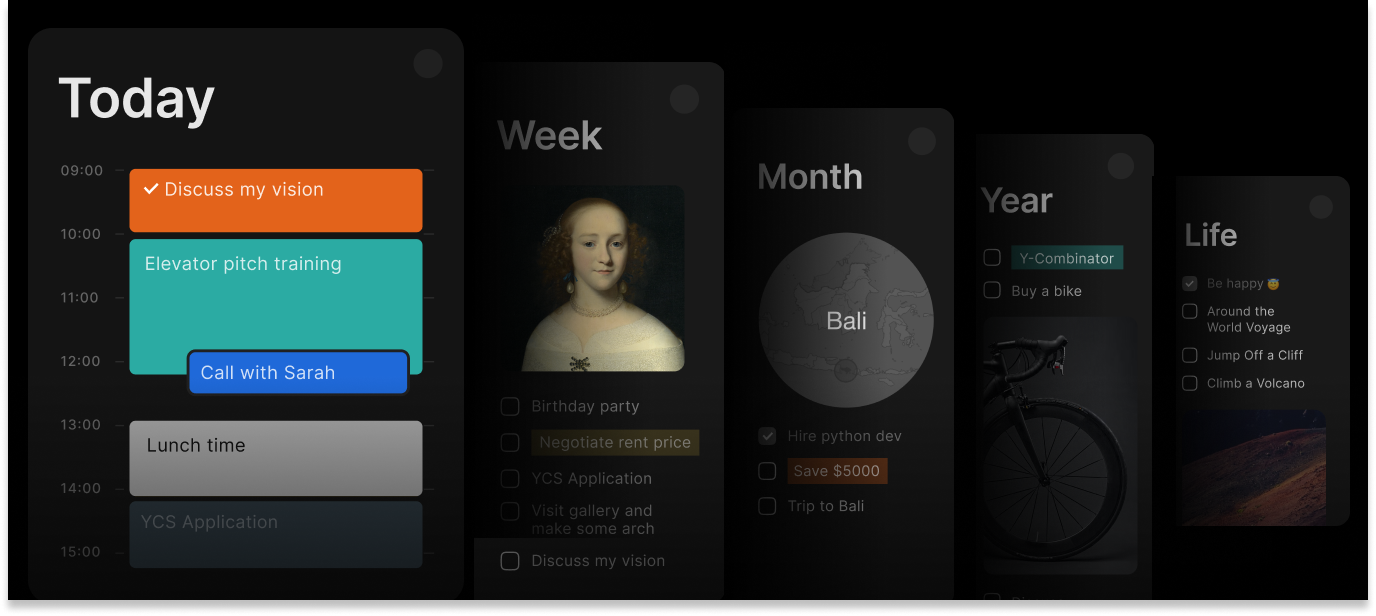
Timestripe is a smart, well-designed workspace for all your projects, tasks and notes.
Try it today
Get StartedThe Psychology Behind Self-Kindness
Self-kindness means treating yourself with the same warmth, understanding, and patience you’d offer a close friend facing difficulty. It’s not about making excuses or lowering standards—it’s about responding to your struggles with support rather than harsh judgment.
Dr. Kristin Neff, a leading researcher in self-compassion, defines it through three core components: self-kindness (being warm toward yourself), common humanity (recognizing that struggle is part of the shared human experience), and mindfulness (holding painful thoughts and feelings in balanced awareness).
Research shows that self-compassion is associated with better physical health, primarily through reduced perceived stress when people respond to their personal failures and struggles with a kind and forgiving attitude.
How Self-Kindness Reduces Internal Resistance
When you approach difficult tasks with self-compassion, you lower the internal resistance that typically blocks action. Think about it: if you know that failing won’t result in a mental beating, you’re more willing to try. Studies show that students who practice self-compassion report increased motivation to address mistakes.
Self-love creates what psychiatrist Dr. Alok Kanojia (often referred to as Dr. K, a Harvard-trained specialist whose work on motivation has been featured on The Mel Robbins Podcast) calls “awareness without autopilot.” Instead of triggering your habitual shame response when you mess up, self-kindness allows you to simply notice what happened, understand it, and respond more effectively.
The Health Benefits Are Real
A comprehensive meta-analysis examining 26 samples with over 6,000 participants found consistent associations between self-compassion and higher self-rated health across diverse populations. The connection between how you treat yourself mentally and your physical health is undeniable.
Why Harsh Self-Talk Damages Consistency
Here’s where most people get it backwards: they think being hard on themselves will drive them to succeed. But negative self-talk actually creates the exact opposite effect.
Dr. Kanojia explains it: “When you’re trying to increase motivation and you put in a lot of work and we’re focused on the outcome and things don’t work out, then I won’t reinforce the behavior. So if I say I’m going to study really hard for a test and I don’t do well on the test, what does my brain learn about the value of studying? That it doesn’t help.”
How Criticism Activates Threat Responses
When you criticize yourself harshly, your brain interprets this as a threat. Neuroscience shows that harsh self-talk activates the same fight-flight-freeze response as external danger. Your amygdala lights up, cortisol floods your system, and your prefrontal cortex—the part responsible for executive function and follow-through—goes offline.
Researches demonstrate that is linked to various mental health challenges, including depression, anxiety, and poorer therapeutic outcomes, as it can lead to internal attributions of failure that exacerbate symptoms.
You literally cannot think clearly or make good decisions when your brain believes you’re under attack, even when that attack is coming from inside your own head.
Why This Destroys Follow-Through
Every time you fail to follow through on something and then mentally punish yourself, you’re training your brain that taking action leads to pain. Your brain, designed to keep you safe, starts working against your goals.
As Dr. Kanojia notes: “If the situation changes and your motivation changes, then you’re screwed. So you’re basically saying the second the alarm rings and you don’t feel motivated, your cognitive willpower starts to drain because you already have to overcome something.”
This is why New Year’s resolutions fail and why gym memberships go unused by February. Your brain is protecting you from what it perceives as a threat.
The Motivation Paradox: You Don't Need to "Feel Motivated"
Here’s a paradigm shift that will change everything: motivation is not a prerequisite for action.
Motivation Is Emotion-Based and Unreliable
Dr. Kanojia explains: “Motivation is not a thing—it is lots of different things. Motivation is an internal drive that comes from emotions, comes from what you should be doing, comes from issues of ego and identity, comes from issues of comparison.”
Because motivation is so heavily tied to emotions, and emotions naturally fluctuate, relying on motivation to drive behavior is like trying to sail a boat when the wind only blows occasionally. Some days you’ll move forward. Most days you’ll sit dead in the water.
How Self-Kindness Stabilizes Behavior
Self-kindness creates what’s called “action-independence”—the ability to act regardless of how you feel in the moment. When you remove the emotional weight of judgment from your actions, behavior becomes simpler: you just do what needs doing.
Research on physical activity found that self-compassion improves barrier self-efficacy, helping individuals overcome obstacles and recuperate from setbacks, leading to more consistent engagement in regular physical activity.
I know that I’ll get through this, "cause I know that I am strong". Cher
Kind Internal Language Increases Willingness to Try
When you speak to yourself with compassion, the stakes of trying (and potentially failing) decrease dramatically. Those who practice self-compassion are more likely to be optimistic and happy, with research showing it can help regulate emotions and reduce symptoms of stress, depression, anxiety, and PTSD.
You’re more willing to apply for that challenging job in 2026's competitive market. More willing to have the difficult conversation. More willing to go to the gym even when you don’t feel like it. Because you know that even if it doesn’t go perfectly, you won’t turn it into evidence of your unworthiness.
How Self-Kindness Builds Real Consistency
Being consistent is showing up repeatedly, even imperfectly. Self-kindness makes this possible in ways that self-criticism never can.
Lower Internal Resistance → Easier Action → More Repetition
Anticipate the difficulty instead of being caught off guard by it.
“Tomorrow when I wake up, I’m not going to feel like going to the gym. I want to mentally prepare for the difficulty. If you’re thinking about going to the gym, you’re thinking about the positive—you’re not thinking about the negative. And then when you run into the negative, the pain of actually going through the act, your brain gets confused because 'I’m thinking about this as a good thing, but my experience of it is as a bad thing.'”
By anticipating that something will be hard and treating yourself kindly anyway, you remove the element of surprise that often derails us.
Removal of “All-or-Nothing” Thinking
Self-criticism breeds perfectionism, which creates an impossible standard: you either do something perfectly or you’re a failure. This all-or-nothing thinking is a consistency killer.
Self-kindness allows for middle ground. You can have an imperfect workout and still honor that you showed up. You can send out a job application that’s good enough rather than waiting for it to be perfect. Research on positive psychology interventions found that increases in self-compassion mediated improvements in well-being.
Greater Resilience After Setbacks
This is where self-kindness truly comes into its own. When you inevitably encounter setbacks — and you probably will — self-compassion allows you to recover quickly.
A three-wave longitudinal study found that self-compassion interventions produce moderate reductions in self-criticism compared to control groups. Self-compassion serves as a protective factor against anxiety and depression.
Rather than spiralling into shame and giving up entirely, you can acknowledge what happened, learn from it and move forward. Simple as it is, we all just need to move forward even after tough setbacks.
The Neuroscience: Kindness Shifts the Brain Out of Survival Mode
Understanding the neuroscience behind self-kindness reveals why it’s so powerful for sustained motivation and performance.
Harshness Triggers Fight/Flight/Freeze
When you engage in harsh self-criticism, your brain’s threat detection system (the amygdala) interprets this as danger. Your nervous system shifts into survival mode, flooding your body with cortisol and adrenaline.
In this state, your brain has one priority: keep you safe right now. It doesn’t care about your long-term goals or your career aspirations. It just wants you to survive the perceived threat.
Moreover, when you’re in threat mode, your brain dramatically overestimates the likelihood of failure and underestimates your ability to handle challenges.
Kindness Activates Learning and Reward Pathways
In contrast, self-kindness activates your brain’s safety system—the parasympathetic nervous system. When you feel safe, your brain shifts into creative « explore mode ».
In explore mode, your prefrontal cortex—responsible for planning, decision-making, and behavior regulation—functions optimally. Your dopamine system responds more appropriately to rewards. Your learning circuits are open and receptive.
This is why cultivating self-love isn’t soft or indulgent—it’s strategically intelligent. You’re literally creating the optimal brain state for learning, growth, and sustained behavior change.
Practical Ways to Be Kinder to Yourself (and Increase Motivation Fast)
Understanding the theory is valuable, but implementation is everything. Here are evidence-based techniques you can use immediately.
1. Anticipate Difficulty Instead of Blaming Yourself
Before attempting any challenging task, take 30 seconds to mentally prepare for the difficulty you’ll encounter.
This simple reframe prevents the surprise that often derails us. As Dr. Kanojia notes: “Anticipating the difficulty is a very important part because then you’re not caught off guard by it."
2. Focus on Micro-Actions to Reduce Overwhelm
Instead of focusing on outcomes (“I need to lose 30 pounds” or “I need to find a new job”), focus on the smallest possible action you can take today, use positive grammar.
In 2026's challenging job market where hiring is projected to increase by only 1.6%, focusing on small, controllable actions prevents paralysis.
3. Practice Gentle Reflection After Actions
This is an important stage, but it is important not to turn it into rumination.
The key is observation without judgment and without issuing verdicts about your worth. You’re collecting data about yourself.
Studies show that giving your brain time to process the consequences of actions supports future behavior in a positive direction.
Use Self-Talk Scripts That Increase Follow-Through
The way you speak to yourself matters. Try these proven scripts if you're sometimes hard on yourself:
When you don’t feel like doing something: “I don’t feel like it right now, and that’s OK. Feelings aren’t commands. I can still do this, even without excitement.”
When you’ve had a setback: “This is just one data point. Setbacks are part of any process worth pursuing. What can I learn from this to do better next time?”
When you’re overwhelmed: “I can’t control everything, but I can control what I do next. What’s one small thing I can do right now?”
When facing uncertainty in the job market: “There is an economic uncertainty, but I can focus on what I control: my skills, my effort, my applications, my growth.”
5. Separate Action from Outcome
This is our favorite powerful technique: focus on the action itself, rather than its outcome.
This approach is particularly crucial as the gig economy continues expanding, requiring more self-direction and intrinsic motivation.
6. Treat Yourself as You Would a Good Friend
Classic one. When you catch yourself in harsh self-criticism, pause and ask: “Would I say this to a friend in the same situation?”
If the answer is no, adjust your language. Researches show that shifting your perspective to treat yourself with the same compassion you’d offer a friend can reduce negative thinking and increase well-being.
Conclusion: The Future of Productivity Is Compassion
We’re witnessing a fundamental shift in how we understand motivation, productivity, and success. The old model—beat yourself into submission, rely on willpower, push through pain—is revealing itself as unsustainable and ultimately self-defeating.
Why Emotional Literacy Is the Future
The next wave of truly effective people won’t be those who can push themselves the hardest. It will be those who understand their internal mechanics well enough to work with their psychology rather than against it. They will craft their environment and tools, including AI, to amplify their natural strengths and cover up their flaws.
Tools as Timestripe can serve as external scaffolding for our internal processes: reminders that work with our memory systems. AI assistants that complement our thinking patterns. Workflows that account for our energy cycles and attention spans. The competitive advantage lies with those who can architect this entire system — self-knowledge, environment, and technology — into a coherent support structure tailored to how they actually function, not how they think they should function.
Health news in 2026 continues to confirm what researchers have known for years: self-compassion is a productive way of approaching distressing thoughts and emotions that engenders both mental and physical well-being. And you can use it.
How Self-Kindness Scales Motivation Sustainably
Unlike motivation that depends on external circumstances or emotional states, self-kindness creates an internal foundation that remains stable regardless of what’s happening around you.
When about 40% of American workers report being unhappy in their jobs but unwilling to leave due to economic concerns, those who have cultivated self-compassion maintain their motivation and well-being even in difficult circumstances.
- Self-kindness scales because it:
- Removes the emotional tax of constant self-judgment
- Makes setbacks less catastrophic and recovery faster
- Creates space for learning and adaptation
- Reduces the internal resistance that blocks action
- Builds genuine resilience rather than brittle willpower
A Call to Build Systems That Support You
The final piece of this puzzle is designing your life to make self-kindness the default.
- Create environments that:
- Make anticipated difficulty visible (write it down: "This will be hard")
- Remove unnecessary decisions (lay out gym clothes the night before)
- Build in reflection time (5 minutes at day's end to observe without judgment)
- Surround you with supportive messages (motivation quotes that emphasize self-compassion, not self-criticism)
- Focus on process metrics you control rather than outcome metrics you don't
In sometimes hurch capitalist world that’s constantly trying to make you feel inadequate so you’ll buy the next solution, self-kindness is an act of revolution. Claim ownership of your internal experience and refuse to let external circumstances dictate your self-worth.
We at Timestripe believe that the motivated person of 2026 is the one who has learned to be their own best advocate, their own wisest counselor, their own most supportive friend.
In an uncertain future, whether in terms of careers, health or the global economy, the greatest competitive advantage you can develop is the ability to treat yourself with kindness, especially when things get hard.
The evidence is clear: self-kindness forms the foundation on which everything else is built. Start today. Start small. And start with kindness.
Read next



Ready to take control of your schedule?
Start your trial of Timestripe today. Your future, more focused and less stressed self, will thank you for committing to intentional time allocation.
Get Started