
ARCO: What The Film Shows About The Way We Work, Live and Love
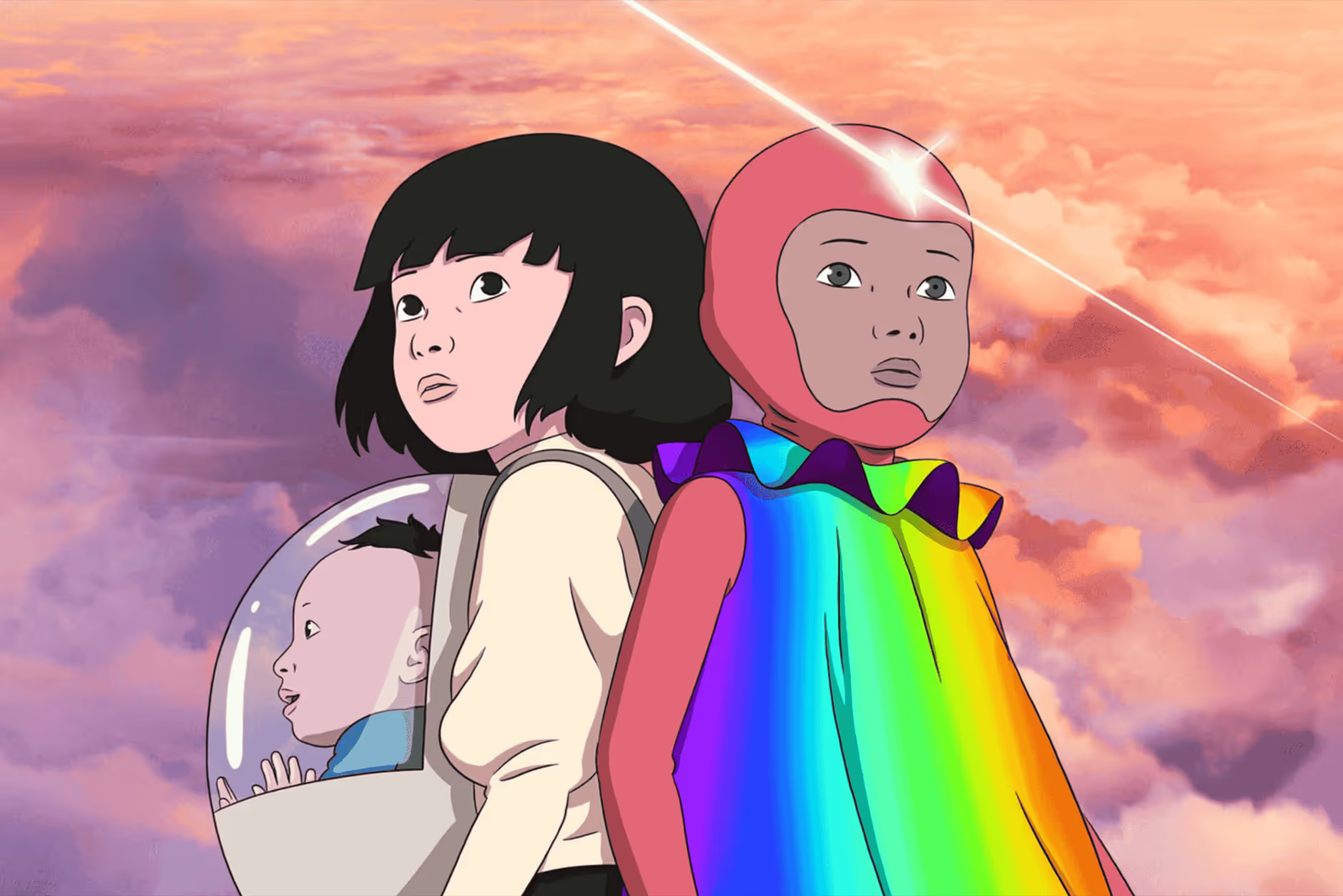
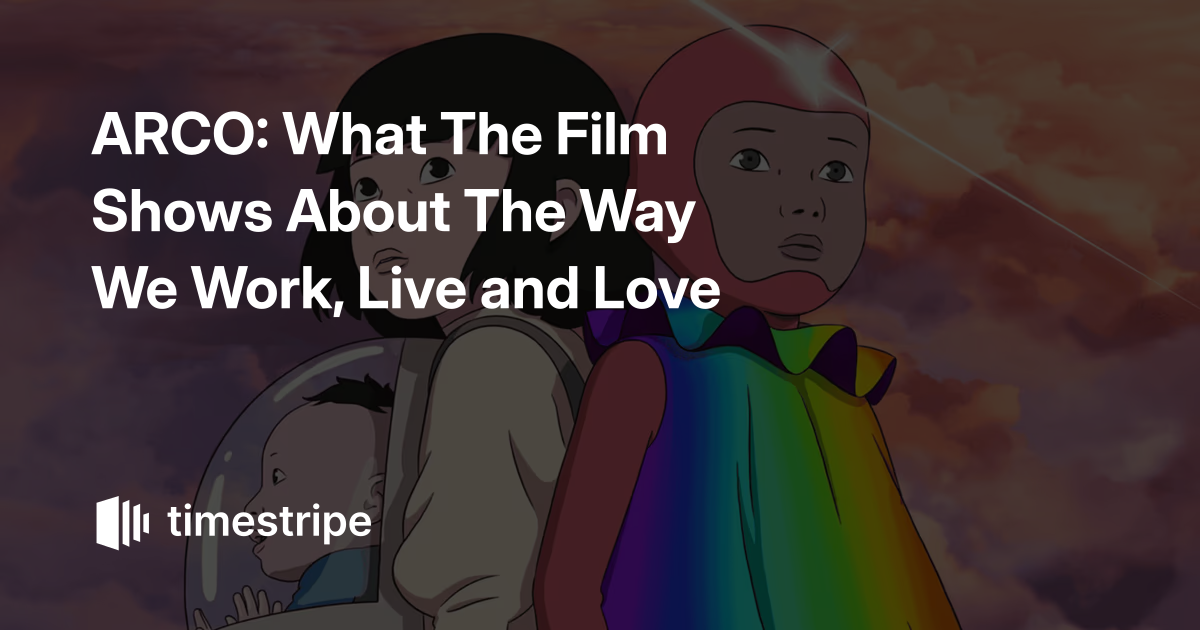
Arco is a science fiction animated film directed by Ugo Bienvenu. Through a story that is accessible to all, the film depicts two very different futures, linked by the encounter between Arco, a little boy from the distant future, and Iris, a girl living in 2075, in a world marked by climate and social crisis.
In this distant future, humanity has mastered time travel, allowing for the exploration of various eras. This is how Arco, dressed in his rainbow cape, accidentally lands in 2075 and meets Iris, the lonely little girl. The meeting of these two children brings a flash of hope and optimism to a bleak future.
How does Arco portray the future of work and technology?
In Iris’s future, work plays a central role in the lives of adults. Parents are functionally absent from home: they are constantly at the office and remain connected to their work through immersive technologies. Their presence within the family is limited to appearances in the form of holograms, which creates a cold and artificial relationship. There is an icy atmosphere, particularly at mealtimes.
The emotional vacuum of 2075 is captured perfectly in one heartbreaking scene: Iris’s mother, appearing only as a flickering hologram, reads her daughter a bedtime story and begins to glitch 'fizzle out’at the very moment of a goodnight kiss.
This scene perfectly illustrates the concept of technological alienation: technology provides a visual substitute for a parent, but it fails to deliver the emotional and physical connection a child needs, leaving Iris in a state of profound loneliness. This partial, artificial presence causes enormous suffering for little Iris, who longs to be reunited with her parents, to be hugged and cuddled.
The film shows how a society that places excessive value on work can weaken family and emotional ties.
In the face of this absence, technology takes over. Humanoid robots take care of domestic tasks and children’s education. Mikki, Iris’s nanny robot, is designed to cook, do household chores, look after the children and entertain them. Equipped with emotional intelligence and empathy, the robot plays the role of a full-time parent. More broadly, robots are replacing humans in many professions, reflecting a society that is highly dependent on technology, where work is becoming increasingly automated, impersonal and dominated by calculation rather than intuition.
This aspect of the film could in itself be an episode of the dystopian series Black Mirror, which denounces the abuse or misuse of technology. However, this is not the case. While the film depicts a bleak future in which parents abandon their children to devote themselves entirely to their work, few science fiction films offer a more “optimistic” view of the use of robots. For once, robots are helping humans and not seeking to destroy them.
This way of life is also linked to a major ecological crisis. The world of 2075 is marked by repeated natural disasters, the consequences of an unsustainable development model. Since people have no control over the vagaries of the weather, they can only protect themselves by locking their houses inside giant bubbles, programmed to envelop their homes and shield them.
Our current choices in terms of production, consumption and work organisation have a direct impact on the future of the planet.
A distant future more utopian / Return to basics
By contrast, the future from which Arco comes appears more peaceful. Humans have had to rise up into the sky to allow the Earth’s surface to breathe, but they seem to have learned from their mistakes and reconnected with nature and each other. Work is more balanced and leaves room for family life, creativity and imagination. The boy’s parents appear to be researchers who are searching for resources and ways to improve life, in a more respectful way.
Compared to Iris’s home, Arco’s family seems very close-knit. They have a strong family life, working from home and raising their children together.
In fact, the catalyst for the film is Arco’s escape, tired of always having his parents on his back. Eager to discover the world for himself, he disobeys and runs away, flying into the air. By mistake, he lands in 2075 and meets Iris. Throughout the film, with Iris’s help, he tries to return home, unaware that his family is also searching for him, travelling through time to find him. It is through his contact with Iris that Arco realises how lucky he is, how important it is to have a family that cares about him.
Through this vision, Arco offers an alternative to a world focused solely on productivity, a world where humanity has rediscovered its essence.
To conclude
In my opinion, the most striking and significant scene in the film is when Mikki, wounded and trapped in the cave with Iris and Arco, carves his memories into the rock. With his robotic hand, he sketches the most beautiful scenes from a life spent alongside the little girl, the important stages of his childhood and the special moments spent in her company, forever marked in stone. This scene is the heart of the film.
Without delivering a direct political message, the film invites viewers to reflect on what is essential. Above all, Arco delivers a humanistic and hopeful message: despite crises, it is still possible to imagine a future where people, relationships and respect for the environment once again take centre stage.
Read next
Try Timestripe Today
Start your trial. Your future, more focused and less stressed self, will thank you for committing to intentional time allocation.
Get Started